Ergodicity economics

Understanding human behavior through the science of time and chance

  • Ergodicity.tv link image Ergodicity.tv
  • Mailing list link image Mailing list
  • Discord server link image Discord server
  • Time, Space, and Climate Damages

    Aug 28, 2025

    Time, Space, and Climate Damages

    Does the way we look at a problem – over time or across an ensemble – change what we see? The main insight from Ergodicity Economics is that when ergodicity is broken, it does. But asking the ergodicity question is not only a great starting point for solving f
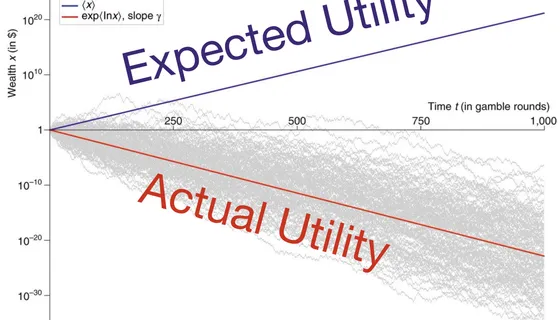

  • Expected-utility maximizers don't maximize utility.

    May 28, 2025

    Expected-utility maximizers don't maximize utility.

    Ergodicity economics is an umbrella term for addressing issues in economics research by carefully considering the ergodicity problem -- that's the problem that the expected value of something may be different from its time average. One key finding which illust

  • The Brussels Experiment

    Feb 26, 2025

    The Brussels Experiment

    Readers of this blog will probably be familiar with the Copenhagen experiment . We conducted a similar but much simpler experiment, and we did it in Brussels, so we’re now calling it the Brussels experiment . What did we find? Our results suggest two things: F

  • Ergodicity economics -- a history

    Feb 5, 2024

    Ergodicity economics -- a history

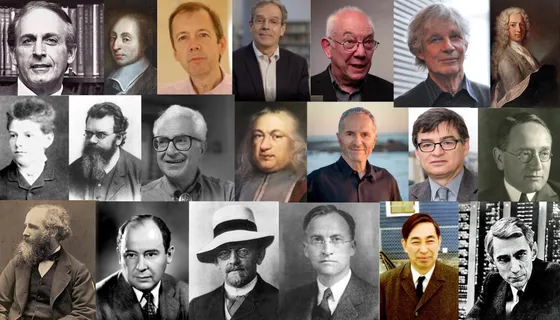
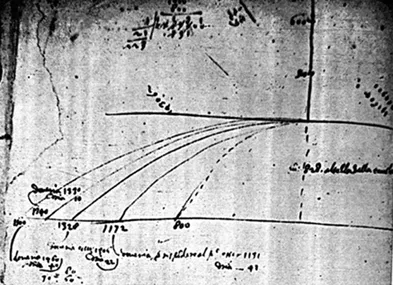
    If you're wondering where ergodicity economics comes from, where it sits in the world of science, then this blog post if for you. I won't go into detail about any of its results. Instead, I will focus on its origins and history. This history is superficial and

  • An ergodicity perspective on reinforcement learning

    Oct 20, 2023

    An ergodicity perspective on reinforcement learning

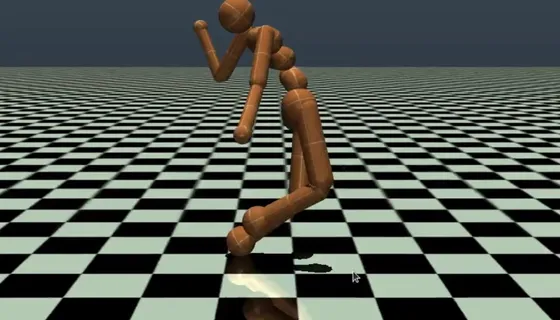
    [elementor_post_thumbnail] “Reinforcement learning, a powerful branch of artificial intelligence (AI), has revolutionized the way machines learn and make decisions. From training autonomous robots to mastering complex games, reinforcement learning holds the ke

  • For to withhold is to perish

    Aug 29, 2023

    For to withhold is to perish

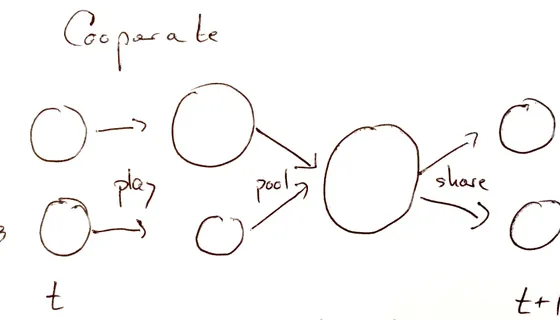
    A central puzzle in evolutionary biology is that of spontaneous altruism. When two creatures interact, why might one sacrifice something of value in order to help the other? Why, if I'm rich, might I want to help the poor? In one view of the problem, there's n

  • Insurance as an ergodicity problem

    Aug 8, 2023

    Insurance as an ergodicity problem

    The business of insurance, by various measures, is the largest industry on earth. Somewhat surprisingly, mainstream economics struggles to explain its existence. This post is about how ergodicity economics approaches the subject, which leads to a glimpse into

  • The infamous coin toss

    Jul 28, 2023

    The infamous coin toss

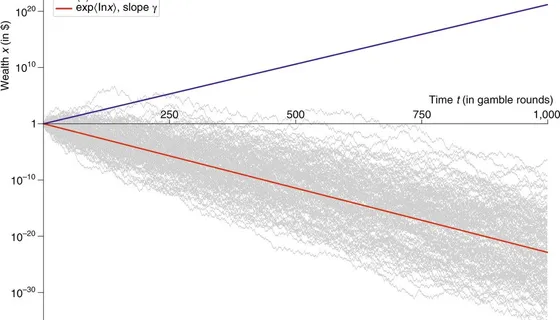
    In 2011 I gave a 15-minute talk to a lay audience in London. The topic I had chosen was ergodicity breaking, and the challenge was clear: how do you get this across? I invented a coin-toss gamble, which has since become a go-to illustration of ergodicity break

  • Probability weighting and Ergodicity Economics

    Mar 6, 2020

    Probability weighting and Ergodicity Economics

    One key observation that helped launch the field of behavioral economics into stardom is called probability weighting: a human cognitive bias to assign higher probabilities to extreme events than ... well, than what? Than what someone else thinks the probabili

  • Democratic domestic product

    Feb 26, 2020

    Democratic domestic product

    Over the years, some words have established themselves at the London Mathematical Laboratory as a useful vocabulary. " Laplacing something" and " Weltschmerz" (p.32) are among these words. Another is "Democratic Domestic Product" or DDP -- a humorous term, lik

  • Ergodicity, jail, and time scales

    May 16, 2019

    Ergodicity, jail, and time scales

    When statistical things go wrong, it's often because someone unknowingly assumed ergodicity where that wasn't ok. This can have dramatic effects in everyday language: I will use the example of incarceration rates. I will then present a visual illustration to d

  • What's a growth rate, really?

    Mar 13, 2019

    What's a growth rate, really?

    Growth rates are at the heart of ergodicity economics, and economic news are full of them, too -- "GDP grew by 3% last year," something like that. Sometimes we also hear "national debt grew by $1,271,000,000,000 over the last year" (which is dimensionally diff

  • The Copenhagen experiment

    May 29, 2018

    The Copenhagen experiment

    A few weeks ago I was made aware of an experiment that was recently carried out in Copenhagen, by a group of neuroscientists led by Oliver Hulme at the Danish Research Center for Magnetic Resonance . Results of the experiment have not been published yet, so th

  • Economics 101: Bertrand Russell is the Pope

    Mar 27, 2018

    Economics 101: Bertrand Russell is the Pope

    If we assume that a false proposition is true, we can prove anything ( ex falso quodlibet ). Bertrand Russell, so the story goes, once mentioned this in class. A student raised his hand and challenged: in that case prove that 1=0 implies that you're the Pope.

  • The trouble with Bernoulli 1738

    Feb 16, 2018

    The trouble with Bernoulli 1738

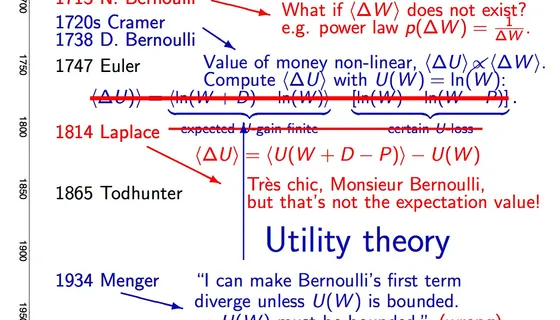
    Not all academic fields have a clear starting point, a seminal paper that constitutes the foundation of the entire discipline. But economics does. The paper that defines modern formal economics was written by Daniel Bernoulli in 1738. It introduces expected ut

  • Max Planck's scheinproblems

    Nov 8, 2017

    Max Planck's scheinproblems

    In June 1946 Max Planck spoke in the Göttingen physics colloquium. Planck was 88 years old, had received the highest honors of his community, including a Nobel Prize in 1918 for his discovery of the quantum, and had profoundly changed how we think about physic

  • Wealth: redistribution and interest rates

    Aug 14, 2017

    Wealth: redistribution and interest rates

    The most interesting scientific projects are those that surprise, when the mathematics, or the code, tells us something we didn't expect. In our study of US wealth dynamics that's what happened. We wrote it up in a paper , but that's only the end product not t

  • Doing a Laplace

    Jul 18, 2017

    Doing a Laplace

    This is a bit of LML jargon that we felt is worth promoting, even though it's terribly unfair to a great mathematician. So please, you admirers of Laplace, don't take offense. What's the story? In 1738 Daniel Bernoulli wrote his famous paper that introduces ex

  • Ink, science, story-telling

    May 8, 2017

    Ink, science, story-telling

    [latexpage] Scientific theorizing is indeed about finding something reliable in the world -- if we're lucky something reliable enough to be called a law. Why do we want something that doesn't change? Deep question. Here's a practical reason: we aim to capture

  • What's in a norm

    Mar 28, 2017

    What's in a norm

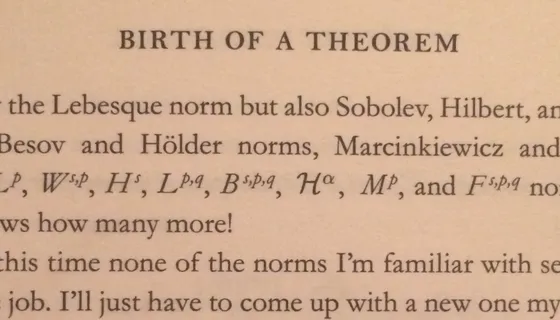
    This is how Cédric Villani puts it [ Birth of a theorem , p.38]: Ask a mathematician the average of a bunch of numbers, and he will likely respond: what average? Geometric, arithmetic, truncated, weighted (with what weight?)... There are an infinity of average

  • Winner take all

    Mar 6, 2017

    Winner take all

    Michael Mauboussin recently re-tweeted an article by Jason Zweig in the Wall Street Journal titled "Disturbing New Facts About American Capitalism" . The article summarizes reports of an increasing concentration of economic power (market capitalization, profit

  • Gas in a box or nuclear explosion?

    Mar 2, 2017

    Gas in a box or nuclear explosion?

    This post is about mindset, culture, implicit assumptions. The big assumption in neoclassical economics is ergodicity, or equilibrium, or stationarity, or stability -- basically the idea that nothing ever changes fundamentally. Things may fluctuate but they al

  • Reproducibility and weak ergodicity breaking

    Feb 14, 2017

    Reproducibility and weak ergodicity breaking

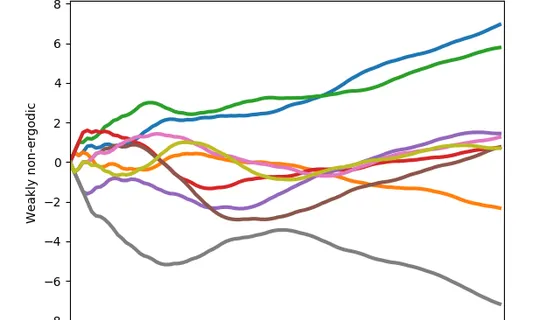
    The term "weak ergodicity breaking" helps categorize things by their ergodic properties: ergodic strongly non-ergodic weakly non-ergodic This list is chronological, in that there used to be an implicit belief that everything was ergodic (from 1654), then the r

  • Placeholder image for right feature one Textbook
  • Placeholder image for right feature two Events
  • Placeholder image for right feature three Archive
© 2026 LML