37 publications

  1. 2025 Book
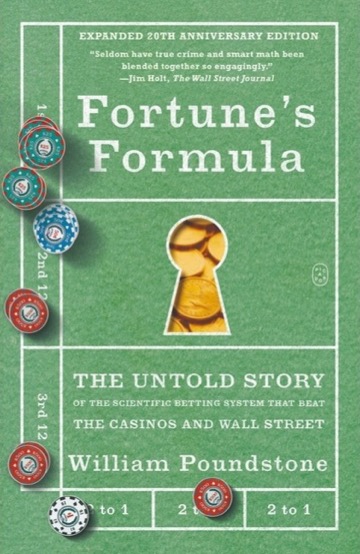
    Fortune's Formula: The Untold Story of the Scientific Betting System That Beat the Casinos and Wall Street

    Poundstone, W. (2025). Fortune's Formula: The Untold Story of the Scientific Betting System That Beat the Casinos and Wall Street (Expanded 20th anniversary ed.). Picador. ISBN 978-1-250-39112-4.

    The twentieth-anniversary edition of this definitive work on the Kelly criterion was expanded to include an account of ergodicity economics.
    • Finance
    • Foundations
  2. 2025 Peer-reviewed / open access
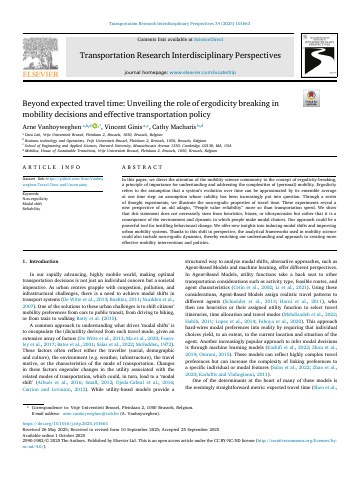
    Beyond expected travel time: Unveiling the role of ergodicity breaking in mobility decisions and effective transportation policy

    Vanhoyweghen, A., Ginis, V., & Macharis, C. (2025). Beyond expected travel time: Unveiling the role of ergodicity breaking in mobility decisions and effective transportation policy. Transportation Research Interdisciplinary Perspectives, 34, 101663.

    Uses thought experiments to show how non-ergodic travel times and absorbing boundaries can make reliability more important than expected speed, with implications for modal-shift policy.

    • Decision theory
    • Absorbing states
  3. 2025 Peer-reviewed
    Investigating the origins of redistributive behaviour in non-ergodic contexts

    Vanhoyweghen, A., Macharis, C., & Ginis, V. (2025). Investigating the origins of redistributive behaviour in non-ergodic contexts. Proceedings of the Royal Society A, 481(2326), 20250598.

    Uses stated-preference experiments with multiplicative gambles to show that redistributive choices can reflect self-interested time-average growth and risk management rather than altruism alone.

    • Inequality
    • Cooperation
    • Experiments
  4. 2025 Textbook
    An Introduction to Ergodicity Economics

    Peters, O., & Adamou, A. (2025). An Introduction to Ergodicity Economics. LML Press. ISBN 978-1-0686491-3-4.

    A one-semester textbook placing the ergodicity question at the centre of economic decision-making.

    • Foundations
  5. 2025 Peer-reviewed
    Reinforcement learning in path-dependent, non-ergodic contexts

    Verbruggen, B., Vanhoyweghen, A., & Ginis, V. (2025). Reinforcement learning in path-dependent, non-ergodic contexts. Proceedings of the Royal Society A, 480(2314), 20240415.

    Introduces a temporal training mechanism that lets reinforcement-learning agents account for path dependence and optimize time-average performance in non-ergodic settings, including a portfolio problem related to the Kelly criterion.

    • Reinforcement learning
    • Methodology
  6. 2025 Peer-reviewed / open access
    Reinforcement learning with non-ergodic reward increments: robustness via ergodicity transformations

    Baumann, D., Noorani, E., Price, J., Peters, O., Connaughton, C., & Schon, T. B. (2025). Reinforcement learning with non-ergodic reward increments: robustness via ergodicity transformations. Transactions on Machine Learning Research.

    Applies ergodicity transformations to reinforcement learning with non-ergodic reward increments, aiming for more robust individual-trajectory performance.

    • Reinforcement learning
    • Methodology
  7. 2023 Peer-reviewed / open access
    Human decision-making in a non-ergodic additive environment

    Vanhoyweghen, A., & Ginis, V. (2023). Human decision-making in a non-ergodic additive environment. Proceedings of the Royal Society A, 479(2278), 20230544.

    Shows experimentally that decision-makers adjust their risk aversion in additive dynamics according to their distance from an absorbing ruin boundary, consistent with sensitivity to non-ergodicity and time-average outcomes.

    • Experiments
    • Decision theory
    • Absorbing states
  8. 2023 Peer-reviewed
    Stable cooperation emerges in stochastic multiplicative growth

    Fant, L., Mazzarisi, O., Panizon, E., & Grilli, J. (2023). Stable cooperation emerges in stochastic multiplicative growth. Physical Review E, 108, L012401.

    Investigates stability of cooperative protocols in stochastic multiplicative growth.

    • Cooperation
  9. 2023 Peer-reviewed / open access
    Insurance as an ergodicity problem

    Peters, O. (2023). Insurance as an ergodicity problem. Annals of Actuarial Science, 17(2), 237-240.

    A concise actuarial-science framing of insurance as a non-ergodic wealth-growth problem.

    • Finance
    • Decision theory
  10. 2022 Peer-reviewed / open access
    The ergodicity solution of the cooperation puzzle

    Peters, O., & Adamou, A. (2022). The ergodicity solution of the cooperation puzzle. Philosophical Transactions of the Royal Society A, 380, 20200425.

    Shows how repeated pooling and sharing can raise time-average growth by reducing effective fluctuations, offering a baseline mechanism for cooperation.

    • Cooperation
  11. 2022 Peer-reviewed / open access
    The influence of ergodicity on risk affinity of timed and non-timed respondents

    Vanhoyweghen, A., Verbeken, B., Macharis, C., & Ginis, V. (2022). The influence of ergodicity on risk affinity of timed and non-timed respondents. Scientific Reports, 12, 3744.

    Uses stated-choice experiments to test whether time pressure changes decisions under additive and multiplicative dynamics.

    • Experiments
    • Decision theory
  12. 2021 Peer-reviewed / open access
    Microfoundations of discounting

    Adamou, A., Berman, Y., Mavroyiannis, D., & Peters, O. (2021). Microfoundations of discounting. Decision Analysis, 18(4), 257-272.

    Derives discounting behavior from decision criteria and dynamics, connecting intertemporal choice to time-average growth reasoning.

    • Decision theory
  13. 2021 Peer-reviewed / open access
    Ergodicity-breaking reveals time optimal decision making in humans

    Meder, D., Rabe, F., Morville, T., Madsen, K. H., Koudahl, M. T., Dolan, R. J., Siebner, H. R., & Hulme, O. J. (2021). Ergodicity-breaking reveals time optimal decision making in humans. PLOS Computational Biology, 17(9), e1009217.

    An experimental test of whether human risk preferences shift with additive versus multiplicative dynamics.

    • Experiments
    • Decision theory
  14. 2021 Working paper
    Risk preferences in time lotteries

    Berman, Y., & Kirstein, M. (2021). Risk preferences in time lotteries. arXiv:2108.08366.

    Applies growth-optimal reasoning to lotteries over payment time and compares it with expected discounted utility theory.

    • Decision theory
  15. 2021 Peer-reviewed / open access
    Wealth inequality and the ergodic hypothesis: evidence from the United States

    Berman, Y., Peters, O., & Adamou, A. (2021). Wealth inequality and the ergodic hypothesis: evidence from the United States. Journal of Income Distribution, 30(1).

    Tests whether a standard wealth-dynamics model equilibrates quickly enough for the ergodic hypothesis to be useful in US wealth-inequality data.

    • Inequality
  16. 2021 Peer-reviewed / open access
    Axiomatic Rationality and Ecological Rationality

    Gigerenzer, G. (2021). Axiomatic rationality and ecological rationality. Synthese, 198, 3547-3564.

    Examines axiomatic and ecological approaches to rationality and how each evaluates decisions.

    • Decision theory
    • Foundations
  17. 2020 Working paper
    Comment on D. Bernoulli (1738)

    Peters, O. (2020). Comment on D. Bernoulli (1738)

    Specifies the difference between Bernoulli's 1738 decision theory and expected utility theory.

    • Decision theory
    • Foundations
  18. 2020 Working paper
    What are we weighting for? A mechanistic model for probability weighting

    Peters, O., Adamou, A., Kirstein, M., & Berman, Y. (2020). What are we weighting for? A mechanistic model for probability weighting. Researchers.One.

    Reinterprets probability weighting as a possible response to uncertainty about probabilities estimated from time series.

    • Decision theory
  19. 2019 Peer-reviewed
    The ergodicity problem in economics

    Peters, O. (2019). The ergodicity problem in economics. Nature Physics, 15, 1216-1221.

    The broad Nature Physics overview that gave the field its clearest public formulation.

    • Foundations
  20. 2018 Peer-reviewed
    Lack of group-to-individual generalizability is a threat to human subjects research

    Fisher, A. J., Medaglia, J. D., & Jeronimus, B. F. (2018). Lack of group-to-individual generalizability is a threat to human subjects research. Proceedings of the National Academy of Sciences, 115(27), E6106-E6115.

    Compares within-person and between-person correlations across six intensive longitudinal datasets, showing that group estimates can poorly represent individual dynamics and motivating explicit tests of generalizability.

    • Foundations
    • Methodology
  21. 2018 DOI
    2018 Peer-reviewed
    Unfair and anomalous evolutionary dynamics from fluctuating payoffs

    Stollmeier, F., & Nagler, J. (2018). Unfair and anomalous evolutionary dynamics from fluctuating payoffs. Physical Review Letters, 120(5), 058101.

    Shows how temporal variation and covariance in payoffs can systematically favor one strategy, producing unexpected cooperation in the prisoner’s dilemma and reversing selection in the hawk–dove game.

    • Cooperation
  22. 2018 Working paper
    The time interpretation of expected utility theory

    Peters, O., & Adamou, A. (2018). The time interpretation of expected utility theory. arXiv:1801.03680.

    Develops the correspondence between utility functions and ergodicity transformations for wealth dynamics.

    • Decision theory
    • Methodology
  23. 2016 Peer-reviewed
    Evaluating gambles using dynamics

    Peters, O., & Gell-Mann, M. (2016). Evaluating gambles using dynamics. Chaos, 26, 023103.

    A compact statement of the ergodicity economics decision-theory perspective: specify dynamics, then evaluate time-average growth.

    • Decision theory
    • Foundations
    • Methodology
  24. 2011 Peer-reviewed
    The time resolution of the St Petersburg paradox

    Peters, O. (2011). The time resolution of the St Petersburg paradox. Philosophical Transactions of the Royal Society A, 369(1956), 4913-4931.

    Recasts the St Petersburg paradox as a problem of time averages versus expectation values.

    • Decision theory
    • Foundations
  25. 2011 Peer-reviewed
    Optimal leverage from non-ergodicity

    Peters, O. (2011). Optimal leverage from non-ergodicity. Quantitative Finance, 11(11), 1593-1602.

    Shows how non-ergodicity in multiplicative finance dynamics leads to a finite optimal leverage and clarifies the limits of ensemble-average reasoning.

    • Finance
  26. 2011 Working paper
    Menger 1934 revisited

    Peters, O. (2011). Menger 1934 revisited. Manuscript.

    Revisits Karl Menger's critique of Bernoulli's logarithmic resolution of the St Petersburg paradox and identifies mathematical errors in Menger's argument.

    • Decision theory
    • Foundations
  27. 2004 Peer-reviewed
    A manifesto on psychology as idiographic science: Bringing the person back into scientific psychology, this time forever

    Molenaar, P. C. M. (2004). A manifesto on psychology as idiographic science: Bringing the person back into scientific psychology, this time forever. Measurement: Interdisciplinary Research and Perspectives, 2(4), 201-218.

    Explains why group-level patterns generally cannot be assumed to describe individual dynamics unless strict ergodicity conditions hold, and argues for idiographic analysis in psychology.

    • Foundations
    • Methodology
  28. 2000 Peer-reviewed
    Wealth condensation in a simple model of economy

    Bouchaud, J.-P., & Mezard, M. (2000). Wealth condensation in a simple model of economy. Physica A, 282, 536-545.

    Introduces a simple stochastic exchange model with multiplicative dynamics, Pareto wealth tails, and a transition between broad inequality and more evenly spread wealth.

    • Inequality
  29. 1998 Book chapter
    Economic Survival

    Radner, R. (1998). Economic survival. In D. P. Jacobs, E. Kalai, & M. I. Kamien (Eds.), Frontiers of Research in Economic Theory: The Nancy L. Schwartz Memorial Lectures, 1983-1997 (pp. 183-209). Cambridge University Press.

    Developed from Radner's Nancy L. Schwartz Memorial Lecture at Northwestern University, this chapter examines economic survival and firm failure as objectives that standard profit- and utility-maximizing models largely neglect.

    • Absorbing states
    • Decision theory
    • Finance
  30. 1997 DOI
    1997 Peer-reviewed
    Risk-sensitivity: crossroads for theories of decision-making

    Kacelnik, A., & Bateson, M. (1997). Risk-sensitivity: Crossroads for theories of decision-making. Trends in Cognitive Sciences, 1(8), 304-309.

    Reviews normative and process-based accounts of animal decision-making under risk, including budget-dependent predictions, risk preferences for variable delays and reward amounts, and the case for theoretical plurality.

    • Decision theory
  31. 1988 DOI
    1988 Peer-reviewed
    Asymptotic optimality and asymptotic equipartition properties of log-optimum investment

    Algoet, P. H., & Cover, T. M. (1988). Asymptotic optimality and asymptotic equipartition properties of log-optimum investment. The Annals of Probability, 16(2), 876–898.

    Extends Breiman’s growth-optimality result beyond independent, identically distributed returns: a portfolio that maximizes conditional expected log return at each step is asymptotically optimal for arbitrary market processes.

    • Finance
  32. 1983 Peer-reviewed
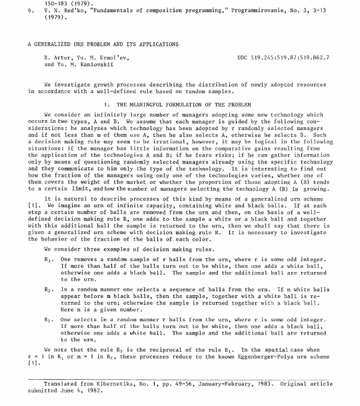
    A Generalized Urn Problem and Its Applications

    Arthur, W. B., Ermoliev, Y. M., & Kaniovskii, Y. M. (1983). A generalized urn problem and its applications. Cybernetics, 19(1), 61–71. https://doi.org/10.1007/BF01070110

    Early use of a non-ergodic model (generalized Polya urns) for modelling an economic process (technological adoption).

    • Foundations
    • Methodology
  33. 1975 DOI
    1975 Book chapter
    Portfolio Choice and the Kelly Criterion

    Thorp, E. O. (1975). Portfolio choice and the Kelly criterion. In W. T. Ziemba & R. G. Vickson (Eds.), Stochastic Optimization Models in Finance (pp. 599–619). Academic Press.

    Extends the Kelly–Breiman framework to portfolios with changing investment opportunities, continuous returns, and some dependence across periods, and contrasts long-run growth optimality with mean–variance analysis.

    • Finance
  34. 1961 LINK
    1961 Proceedings
    Optimal Gambling Systems for Favorable Games

    Breiman, L. (1961). Optimal Gambling Systems for Favorable Games. Proceedings of the Fourth Berkeley Symposium on Mathematical Statistics and Probability, Volume 1, 65-78.

    Connects favorable repeated gambling to long-run growth, making explicit the time-average logic behind optimal betting systems.

    • Finance
    • Foundations
  35. 1956 DOI
    1956 Peer-reviewed
    A New Interpretation of Information Rate

    Kelly, J. L. Jr. (1956). A New Interpretation of Information Rate. The Bell System Technical Journal, 35(4), 917-926.

    Introduces the growth-optimal betting criterion, a central predecessor of time-average reasoning in finance and decision theory.

    • Finance
    • Foundations
  36. 1886 Book
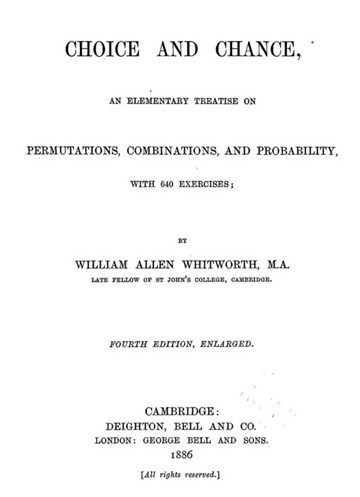
    Choice and Chance: An Elementary Treatise on Permutations, Combinations, and Probability, with 640 Exercises

    Whitworth, W. A. (1886). Choice and chance: An elementary treatise on permutations, combinations, and probability, with 640 exercises. Cambridge: Deighton, Bell & Co.

    A nineteenth-century introduction to combinatorics and probability built around worked problems and an extensive collection of exercises.

    • Foundations
  37. 1738 DOI
    1738 Classic / translation
    Exposition of a New Theory on the Measurement of Risk

    Bernoulli, D. (1954 [1738]). Exposition of a New Theory on the Measurement of Risk. Econometrica, 22(1), 23-36.

    The canonical origin of expected utility theory, and therefore an essential foil for ergodicity economics.
    • Decision theory
    • Foundations